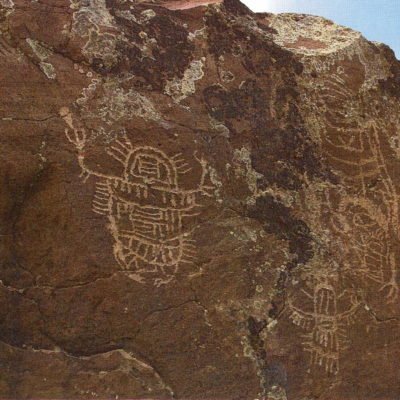
Humans have lived in Wind River Country for thousands of years. The earliest inhabitants left behind signs of their presence in the form of stone tools, wood structures, tipi rings, and rock art. Historians believe rock art was used to record events, mark important places, worship, or simply as a form of creative expression. Although no one knows the exact significance of the images left behind in Wind River Country, their mystery and beauty is alluring and there are several sites visitors can explore and conjure up their own interpretation of these pictures from the past.
Castle Gardens, an oasis created by outcropping of sandstone cliffs in the middle of the windswept plains of Wind River Country, has some of the finest examples of rock art in the area. The rock here has been eroded into turrets and towers by the wind and its soft surface was etched and caved into elaborate shapes and designs by Native Americans thousands of years ago. The most famous of the petroglyphs found here are known as the Castle Gardens Shield Style. These glyphs depict warriors with shields and shields alone, and are made both through etching or chipping at the rock as well as by painting the images with colors made from local minerals.
Castle Gardens’ mystery is enhanced by its remote location. To reach the site, you travel 45 miles east from Riverton over rough roads through barren desert. Suddenly the rocks rise up before you and you enter the sheltered world that has provided travelers with sanctuary for thousands of years. The site is maintained by the Bureau of Land Management and you’ll find picnic facilities and interpretive signs to help you enjoy your visit.
You can also see rock art in the mouth of many of the canyons in Wind River Country. The most famous of these are found in the Dinwoody and Torrey basins near Dubois. These petroglyphs are believed to have been the work of the Sheepeater Indians, who inhabited the area prior to the arrival of European trappers and settlers.
The Sheepeaters, who were also known as the Mountain Shoshone and are thought to be ancestors of the modern-day Shoshone, were named for their reliance on bighorn sheep. They built elaborate traps that funneled the sheep into enclosures where they could be killed easily. Today the Dubois Museum and the National Bighorn Sheep Interpretive Center offer detailed exhibits on the Sheepeaters and their unique hunting techniques, as well as on their art, tools and lifestyles. You can arrange for tours of both the petroglyphs sites and the bighorn sheep traps through the Dubois Museum.